“……It is not enough for a party to state that they have a lease or title to the property” – The Supreme Court in Dina Management V County Government of Mombasa & 5 Others Petition No. 8 (E010) of 2021 (31 March 2023) (Judgment) [2023]
INTRODUCTION
The sanctity of property is a jealously guarded right in all civilizations. In Kenya, the attachment to the land is passionate, emotional and almost fanatical. Nations, neighbours, siblings, spouses and even strangers fight over land. In some instances, the disputes degenerate into bloodshed and death.
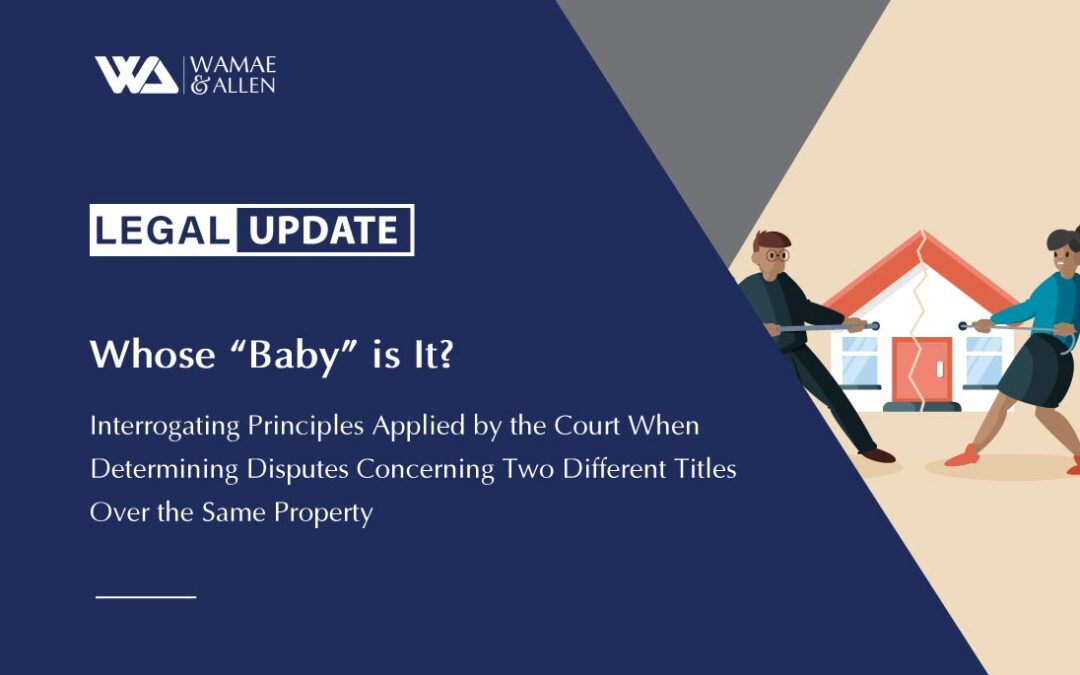
Disputes concerning ownership of land are rife in our society. This is attributed to the fact that land is not only the most important factor of production in Kenya but also a very emotive issue in Kenya. One of the most common disputes touching on land is those where two parties lay claim over the same parcel of land on the basis of two different titles. What ensues is a painstaking investigation by the court in a bid to discover which of the two titles should be upheld. This paper will discuss the factors used by the court in upholding or rejecting either title in such situations.
Presbyterian Foundation v Kibera Siranga Self Help Group Nursery School (Civil Appeal 64 of 2014) [2023] KECA 371 (KLR) (31 March 2023) (Judgment)
FACTS
This was an Appeal preferred by the Presbyterian Foundation (the appellant) against the judgment of the High Court of Kenya. The Appellant had sued the Respondent claiming ownership of the suit property together with the developments erected thereon. According to the Respondent, it granted the appellant’s church a license to occupy the aforesaid premises but in breach of the said authorization, the appellant claimed ownership of the land. On its part, the Appellant denied knowledge of any such licence and claimed that it was allocated the plot by the Commissioner of lands vide a letter of allotment.
After evaluating the evidence, the trial judge was satisfied that the respondent had proven its case to the required standard and affirmed its ownership of the suit property. In particular, the learned judge was satisfied that the respondent established by way of documents that they were allocated the land, they accepted the allotment and paid the requisite rates and land rent as evidenced by receipts produced in court. Further, after the payments, the land was surveyed and a beacon certificate was issued followed by a title deed issued to the respondent under the Registration of Titles Act. Ostensibly, the Appellant was not happy and preferred an Appeal in its bid to regain the property.
DECISION OF THE COURT OF APPEAL
- Firstly, the Court of Appeal observed that the best evidence of ownership of immovable property is the title to it and emphasised the significance of examining the root of the title. The root of title is the deed to which title to a property is ultimately traced to prove that the owner has a good title.
- Secondly, when there are competing interests, the parties are required to give evidence of title starting with a “good root of title.” A good root of title evidence and an unbroken chain of ownership is required. According to the Court, to be a good root of title, a document must satisfy each of the following requirements:
- it must deal with or show the origin of the ownership of the whole legal and equitable interest in the land in question;
- it must contain a recognizable description of the property;
- it must not contain anything that casts any doubt on the title.
Thirdly, each party must provide a credible explanation as to how they became the owners of the property. Such an explanation must be corroborated by the supporting documents which must show a clear origin, and an unbroken chain of the origin of the title to the issuance of the title (including providing a letter of allotment or sale agreement, evidence of payment of the purchase price, transfer form, evidence of payment of rates and land rent, survey, beacon certificate and issuance of a title deed). Where a party’s documents are not only marred by material inconsistencies and contradictions but also lack credibility, the court will disbelieve their title.
Fourthly, the Court of Appeal also held that a title that is first in time cannot be defeated by a later title. This is in line with the principle set out in the case of Wreck Motors Enterprises v Commissioner of Lands C.A. No. 71/1997 (unreported) where the Court held that equity demands that the first in time prevails so that in the event where there are two titles in respect of the same parcel of land, then if both are apparently and on the face, they were issued regularly and procedurally without fraud save for the mistake, then the first in time must prevail.
The above findings are supported by several decisions of our superior courts. For example, the High Court (Sila, J) in Hubert L. Martin & 2 Others v Margaret J. Kamar & 5 Others (2016) eKLR confronted with a similar situation stated:
“A court when faced with a case of two or more titles over the same land has to make an investigation so that it can be discovered which of the two titles should be upheld. This investigation must start at the root of the title and follow all processes and procedures that brought forth the two titles at hand. It follows that the title that is to be upheld is that which conformed to procedure and can properly trace its root without a break in the chain. The parties to such litigation must always bear in mind that their title is under scrutiny and they need to demonstrate how they got their title starting with its root. No party should take it for granted that simply because they have a title deed or certificate of lease, then they have a right over the property. The other party also has a similar document and there is therefore no advantage in hinging one’s case solely on the title document that they hold. Every party must show that their title has a good foundation and passed properly to the current title holder.”
IMPLICATIONS OF THE JUDGMENT: INTERROGATING THE PRINCIPLE OF INDEFEASIBILITY OF TITLE
As a result of the judgment, there is need to interrogate the principle of “bonafide purchaser of land” who under our law, by virtue of Section 26 of the Land Registration Act, enjoys an “indefeasible title”. Under section 26 of the Land Registration Act, a certificate of title is held as conclusive evidence of land ownership and shall not be subject to challenge, except—
- on the ground of fraud or misrepresentation to which the person is proved to be a party; or
- where the certificate of title has been acquired illegally, unprocedurally or through a corrupt scheme.
In Lawrence Mukiri V. Attorney General & 4 Others [2013] eKLR, it was held that for a purchaser to successfully rely on the bona fide doctrine, he must prove ALL of the following:
-
- He holds a certificate of Title.
- He purchased the Property in good faith;
- He had no knowledge of the fraud;
The vendors had apparent valid title;
- He purchased without notice of any fraud; and
- He was not a party to any fraud.
It is a hallowed legal principle that one cannot pass a better title than they have, as was affirmed by the Court of Appeal in Wambui v Mwangi & 3 others (Civil Appeal 465 of 2019) [2021] KECA 144 (KLR) (19 November 2021) (Judgment). Therefore, where the initial owner did not have a good tittle, subsequent owners cannot have a good title. For instance, In Arthi Highway Developers Limited vs. West End Butchery Limited & 6 others [2015] eKLR, the court struck down as invalid titles transferred to bona fide purchasers, after having found that there was fraud in the initial transfer from the first owner.
Recently, the Supreme Court affirmed this principle in Dina Management V County Government of Mombasa & 5 Others Petition No. 8 (E010) Of 2021 (31 March 2023) (Judgment) [2023], where it held that where the first title was acquired irregularly, unlawfully or illegally, the first owner has no valid legal interest which he can pass to subsequent owners. According to the Supreme Court, such titles are not protected by Article 40 of the Constitution since the root title was invalid. On a cursory basis, the supreme court affirmed that where the registered proprietor’s root title is under challenge, it is not enough to dangle the instrument of title as proof of ownership for the registered proprietor must go beyond the instrument and prove the legality of the title and show that the acquisition was legal, formal, and free from any encumbrance.
In light of the above principles, the common consensus among the courts is that a court of law cannot protect title to land which has been obtained illegally or fraudulently merely because a person is entered in the register as a proprietor. This makes it important that every purchaser of Land must conduct comprehensive due diligence and not just an official search. Where the property is prime and obviously bound to be attractive and lucrative, one ought to have been more cautious in undertaking its due diligence. For instance, in the case of Ibrahim v Hassan & Charles Kimenyi Macharia, Interested Party [2019] eKLR, the court held that a search alone was not enough to curb the risk of acquiring property that has a defective title.
However, one may criticize the need to investigate the root title on the grounds that it offends the very essence of the Torrens system of registration. The essence was to save persons dealing with registered proprietors from the trouble and expense of going behind the register, in order to investigate the history of their author’s title and to satisfy themselves of its validity. That end under common law was accomplished by providing that everyone who purchased, in bona fide and for value, from a registered proprietor, and enters his deed or transfer on the register, shall thereby acquire an indefeasible right, notwithstanding the infirmity of his author’s title.
One may also argue that requiring the investigation of the root of the title would hamper the use of land as collateral from financial institutions. Put differently, if the register (or a search) now means absolutely nothing, we might as well forget these objectives of land registration.
The implications for innocent individual Kenyans in particular and the national economy in general, are depressing to fathom. We think the case for protection of the bona fide purchaser for value without notice is as valid as ever. That protection, however, should not extend to a purchaser who has failed to conduct due diligence or has been complicit in the misrepresentation, mistake, fraud or illegality that is said to vitiate the title.
This article is provided free of charge for information purposes only; it does not constitute legal advice and should be relied on as such. No responsibility for the accuracy and/or correctness of the information and commentary as set in the article should be held without seeking specific legal advice on the subject matter. If you have any query regarding the same, please do not hesitate to contact Litigation or Real Estate & Securitization Department at Litigation@wamaeallen.com; or ConveyancingWA@wamaeallen.com
About the author

Frankline M. Otieno is a dispute resolution associate, recommended professional and committed to offering sustainable client-centred solutions to legal issues.Frankline is astute in commercial litigation, securities law, banking law, intellectual property litigation, public procurement, land law litigation, Judicial Review and Administrative law litigation, sports law, tax litigation, administrative law, consumer protection law, competition law and constitutional litigation.