“Public bodies have a constitutional duty to give people access to information so that they can exercise their rights. When they try to subvert a person’s constitutional right by being unresponsive and playing possum their conduct should be deprecated.” – Justice John Mativo in Khelef khalifa and Another v Principal Secretary, Ministry of Transport, and Others delivered on 13th May 2022.
INTRODUCTION
Access to information is critical for enabling citizens to exercise their voice, to effectively monitor and hold government to account, and to enter into informed dialogue about decisions which affect their lives. It is seen as vital for empowering all citizens, including vulnerable and excluded people, to claim their broader rights and entitlements. But the potential contribution to good governance of access to information lies in both the willingness of government to be transparent, as well as the ability of citizens to demand and use information – both of which may be constrained in low-capacity settings. A key question in this regard is: To what extent can access to information, and government transparency, advance the claims of poor and marginalised groups and make governments accountable?
Articles 10 and 35 of the Kenyan Constitution were intended to be the end of secrecy in governance and usher in a new dawn, where the foundational values of our democracy such as transparency and accountability were to be our constant north. In a system of government that prides itself on being hinged on the sovereignty of the people, the participation of the people is indispensable. In this petition, the High Court of Kenya at Mombasa stepped in to vindicate the principles of good governance and assert the value of transparency and accountability in our governance set-up.
FACTS
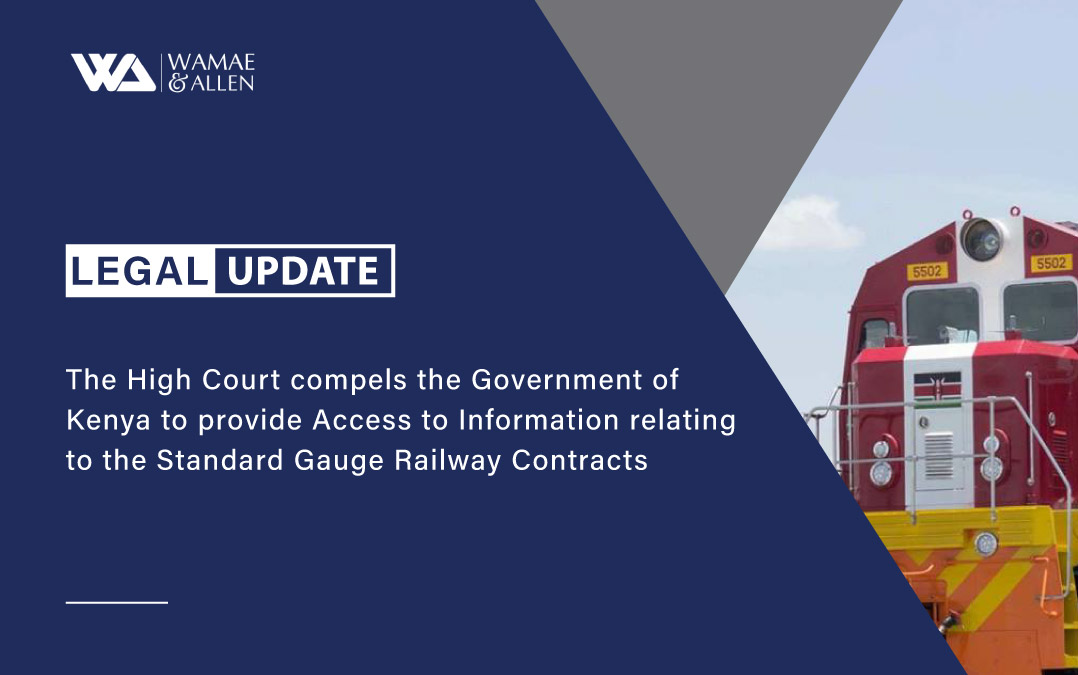
The thrust of the petitioner’s case was that the now-famous or even infamous SGR mega project had gobbled up an estimated 4.5 billion US Dollars in public expenditure, was a government-to-government turnkey operation negotiated in the shroud of opaqueness and dumped upon the Kenyan population with the minimum of scrutiny.
According to the Petitioners, so secretive was the conception and actualisation of the project, that information concerning its financing, tendering process and construction, remains a mystery to date. Further, they state that the Court of Appeal in Okiya Omtatah Okoiti & 2 others v Attorney General & 4 others [2020] eKLR (Koome, Gatembu & J. Mohammed JJ.A), affirmed that the SGR project was procured in violation of Article 227(1) of the Constitution and sections 6(1) and 29 of the Public Procurement and Disposal Act.
Lastly, the petition was based on the fact that the huge capital outlay of both the initial and recurrent expenditure necessitated the involvement of the public through frank and candid access to information. The Respondents declined the 1st Petitioner’s request to provide the information sought by providing a litany of excuses based on Section 6 of the Access to Information Act which provides for the limitations of the right to access information. The Respondents on the other hand argued that the access to information request, if granted would endanger national security and that the information sought is protected under Section 3(6) (7) of the State Secrets Act.
THE RATIO DECIDENDI
First, the judge made a finding that the evidence on record led to the inescapable conclusion that the Respondents were acting in bad faith, an act which was not immunised by statute since public power is meant to be exercised in good faith and for the benefit of the people.
Secondly, according to the Court, Public authorities can no longer abuse the doctrine of exhaustion to claim that a petitioner has not exhausted the internal remedies available under the statute, especially where the statutory text is permissive in nature because of the use of a word such as “may” just as in Section 14 of the Access to Information Act (ATI Act). Here, the judge presented a textualist argument by saying: “Had Parliament desired the mechanism provided therein to be mandatory, it would have done so in clear terms.”
The learned judge then delved into a purposive interpretation of the ATI Act, by highlighting the main object of the Act which was to provide quick and cheap means of obtaining information.
The respondent’s argument of using Sections 3 (6) & (7) of the Official Secrets Act was found to be pretextual and unconstitutionally compliant. The Court used the read in powers granted by section 7 of the 6th Schedule of the Constitution which requires all laws that were enacted before the coming into force of the 2010 constitution to be construed with the alterations, adaptations, qualifications and exceptions necessary to bring it into conformity with this Constitution. Therefore, all access to information requests must be assessed using the framework provided by article 35 and can only be limited as provided by article 24 of the Constitution, and not the State Secrets Act.
In conclusion, the court found that the Respondents had breached the petitioners right to access information by failing to provide the information sought, which prompted the court to compel them to provide the information sought by the 1st Petitioner in his access to information request letters dated 16th December 2019 and 13th May 2021.
IMPLICATIONS OF THE JUDGMENT
This judgment is a reminder that while the right to access information can be lawfully, reasonably and justifiably limited by article 24 of the constitution, the burden of establishing that the refusal of access to information is justified rests on the state or any other party refusing access. The court fortifies the holding in the case of Zebedeo John Opore v The Independent Electoral and Boundaries Commission [2017] eKLR, at paragraph 20 that this burden is only satisfied where the state has put forward sufficient evidence for a court to conclude that, on the probabilities, the information withheld falls within the permissible human rights limitations under article 24 of the constitution; for being lawful, reasonable and justifiable, proportional and legitimate.
Another hurdle that a denial of access to information request must overcome is that refusal to provide access based on grounds of national security exemptions must be geared towards a legitimate national security interest which would be harmed by providing the information sought. As was stated by Edwin A ‘Realizing the Right of Access to Information in Kenya: What Should Stakeholders Be on the Lookout For?’ in Fatima Diallo and Richard Calland (eds), Access to Information in Africa: Law, Culture and Practice (Brill 2013), p. 215.
“Information is power. Indeed, there are several benefits that accrue if the right information is available to the public. Primarily, access to the right information has an impact on the enjoyment of other fundamental entitlements that are due to human beings”
Was the right to access information intended to be rendered inoperative by ignoring requests? There can be no right without a remedy. Justice Mativo also provides a solution to what has been an Achilles heel to most access to information requests: failure to act on ATI requests. The judge holds that the failure to make a decision, in the context of the ATI Act, migrates into a refusal of the request, to promote the culture of justification that permeates the Access to Information Act.
In conclusion, this is a landmark case on access to information held by government and state entities. It is our hope that the government will comply with the terms of the judgement and make available all information regarding the SGR mega project where an estimated 4.5 billion US Dollars of taxpayer’s monies were used in the said project.
This article is provided free of charge for information purposes only; it does not constitute legal advice and should be relied on as such. No responsibility for the accuracy and/or correctness of the information and commentary as set in the article should be held without seeking specific legal advice on the subject matter. If you have any query regarding the same, please do not hesitate to contact Litigation vide litigation@wamaeallen.com
About the author

Caxstone specializes in civil, employment and labour disputes, constitutional law, family law and succession, and environment and land matters. He has amassed a wealth of knowledge and experience in litigation which is evident in the successes obtained for clients. He is an active member of the Employment and Labour Relations Court Bar-Bench committee.

Frankline M. Otieno is a dispute resolution associate, recommended professional and committed to offering sustainable client-centred solutions to legal issues.Frankline is astute in commercial litigation, securities law, banking law, intellectual property litigation, public procurement, land law litigation, Judicial Review and Administrative law litigation, sports law, tax litigation, administrative law, consumer protection law, competition law and constitutional litigation.