
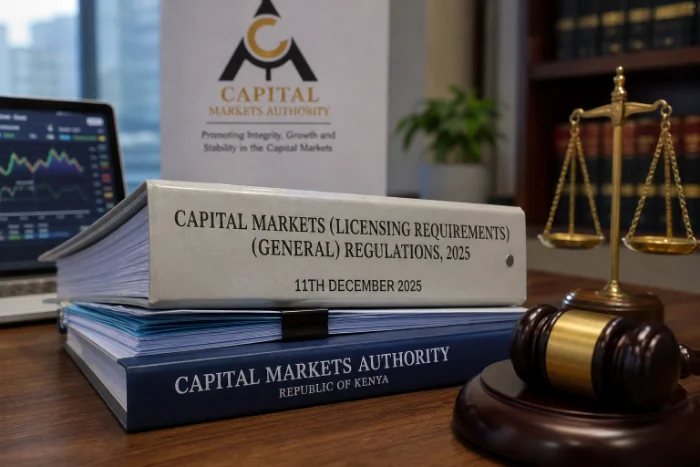
A commentary on the systemic shift from discretionary innovation to statutory rigidity and the analytical warnings on the rising cost of regulatory non-compliance.
“The 2025 Regulations represent a fundamental departure from the era of regulatory accommodation. We are witnessing the birth of a Zero-Trust market architecture where institutional strength is no longer assumed, but mandated.”
Introduction: The Strategic Pivot to Institutional Resilience
The enactment of the Capital Markets (Licensing Requirements) (General) Regulations, 2025 (the “Regulations”), which came into force on 11th December, 2025, marks a defining moment in Kenya’s financial trajectory.
This shift represents a fundamental, systemic restructuring of the capital markets landscape. By repealing the 2002 regime which governed the sector for nearly a quarter-century, the Capital Markets Authority (CMA) has signaled a decisive shift from a market-building posture to one of Institutional Fortification.
In an era defined by volatile global capital flows and the disruptive emergence of decentralized finance, these Regulations act as a Regulatory Zero Trust Architecture. They acknowledge that for Kenya to maintain its status as a regional financial hub, the permissive flexibility of the past must yield to statutory rigidity and heightened capital buffers.
The mandate is clear that all existing licensees must achieve full compliance by 11th December 2026. This twelve-month window is not merely a grace period as it is a strategic interval for market players to de-risk their operations, recapitalize their balance sheets, and align their governance with international best practices.
The Analytical Framework: Three Pillars of the 2025 Shift
To understand the magnitude of this Regulatory Revitalization, practitioners and financial sector players must analyze the Regulations through three distinct lenses:
-
The Capital Imperative (Financial Sanctuary)
The aggressive upward revision of minimum capital thresholds doubling for Securities Exchanges and quadrupling for Fund Managers is a calculated move to ensure that only institutions with genuine skin in the game remain at the core of the ecosystem. This minimizes systemic contagion and ensures that intermediaries can weather macroeconomic shocks without compromising investor funds.
The tabular interpretation is as below;
| License Category | Core Statutory Capital | Liquidity & Risk Buffers |
| Tier 1: Infrastructure | Kes 1 Billion | Highest oversight; focus on systemic stability. |
| Tier 2: Custodial Services | Kes 50 Million | Kes 25M (or 8% of liabilities) in liquid assets. |
| Tier 3: Investment Banking | Kes 150 Million | Kes 50M (or 8% of liabilities) in liquid assets. |
| Tier 4: Broker-Dealers | Kes 70 Million | Kes 50M (or 8% of liabilities) in liquid assets. |
| Tier 5: Stockbroking | Kes 50 Million | Kes 30M (or 8% of liabilities) in liquid assets. |
| Tier 6: Asset Management | Kes 20 Million | Focused on Kes 20M core capital for Fund Managers. |
| Tier 7: Professional Services | Kes 20 Million | Trustees require Kes 5M (or 8% of liabilities) liquid. |
| Tier 8: Specialized Advisory | N/A | Mandatory Kes 500,000 Professional Indemnity. |
-
The Digital Perimeter (Technological Governance)
By formalizing the status of Over-the-Counter platforms, Intermediary Service Platforms, and AI-driven advisory, the Regulations dismantle the Shadow Markets. The law has caught up with technology, ensuring that digital innovation no longer operates in a regulatory vacuum but adheres to strict fiduciary and data protection standards.
-
The Governance Mandate (Professional Integrity)
The introduction of strict tenure limits for leadership and the formalization of Trustee and Custodian licensing underscores a shift toward transparency. It moves the sector away from personality-driven leadership toward institutional-grade governance, where professional privilege is protected by rigorous oversight rather than tradition alone.
Conclusion
As the December 2026 deadline approaches, the choice for sector members is binary: adapt to this new era of fortification or face institutional obsolescence. The 2025 Regulations have effectively redefined the legal sanctuary of the capital markets compliance is no longer a checklist, but the uncompromising pillar of professional survival.
This article is provided free of charge for information purposes only; it does not constitute legal advice and should be relied on as such. No responsibility for the accuracy and/or correctness of the information and commentary as set in the article should be held without seeking specific legal advice on the subject matter. If you have any query regarding the same, please do not hesitate to contact our Banking & Finance, Commercial & Corporate Department vide WACommercial@wamaeallen.com
About the author


Frankline M. Otieno is a dispute resolution associate, recommended professional and committed to offering sustainable client-centred solutions to legal issues.Frankline is astute in commercial litigation, securities law, banking law, intellectual property litigation, public procurement, land law litigation, Judicial Review and Administrative law litigation, sports law, tax litigation, administrative law, consumer protection law, competition law and constitutional litigation.

Denis Mutugi specializes in Commercial Litigation and Alternative Dispute Resolution.
Denis graduated with a Bachelor of Laws, LLB (Hons) from The University of Nairobi in 2021 and was admitted to the Roll of Advocates of the High Court of Kenya in the year 2023.
Denis has amassed a considerable wealth of experience in conducting legal research on various complex legal matters touching on Commercial, Insurance, Employment and Insolvency law and bankruptcy.