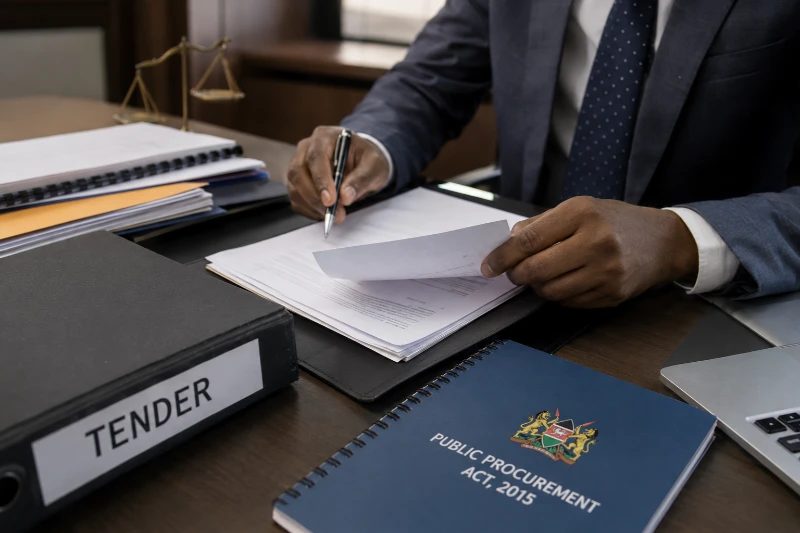
“Procurement must conform to the provision of Article 227 of the Constitution even when done pursuant to the obligations of a treaty or agreement or any other procedure. The use of any procurement method including direct procurement does not exclude the principles of fairness, equitability, transparency, competitiveness, and cost-effectiveness” – PM Mwilu DCJ, MK Ibrahim, SC Wanjala, N Ndungu & W Ouko SCJJ, Kenya Railways Corporation & 2 others v Okoiti & 3 others, Petition 13 & 18 (E019) of 2020 (Consolidated) [2023] KESC 38 (KLR), Supreme Court of Kenya, 16 June 2023
Introduction
In Kenya, tenderers frequently expend significant resources crafting bids, only to face defeat due to superior competition or compromised procurement processes. Consequently, the immediate consideration for an aggrieved bidder revolves around the availability of legal recourse. While the law provides substantive remedies, these are heavily regulated by strict procedural rules, inflexible deadlines, and a mandatory sequence of dispute resolution, as recently reaffirmed by the Supreme Court. This legal framework is deeply informed by the Supreme Court judgment in Kenya Railways Corporation & 2 others v Okoiti & 3 others (the “SGR case”), which scrutinized procurement law through a profound constitutional lens.
The Constitutional Baseline
To wit, any fundamental analysis of bid challenges in Kenya must be anchored in the Constitution. Under Article 227(1) of the Constitution of Kenya 2010, every State organ or public entity must contract for goods or services utilizing a system inherently defined by fairness, equitability, transparency, competitiveness, and cost-effectiveness.
For the unsuccessful tenderer, this serves as an absolute guarantee: procuring entities cannot bypass this constitutional baseline by hiding behind special exemptions or government-to-government frameworks. The fundamental principles of fairness and transparency are mandatory requirements that persist regardless of the procurement method employed.
Where to Fight and When
The PPADA 2015 dictates a strict, tiered hierarchy for legally challenging procurement determinations. An aggrieved tenderer possesses three primary avenues:
- Stage One: Internal Review: Ordinarily, a tenderer must first request an internal review from the procuring entity’s accounting officer before elevating the matter to the PPARB.
- Stage Two: The PPARB: Should internal review prove unsatisfactory, the dispute may be escalated to the PPARB.
- Stage Three: Constitutional Petitions and Judicial Review: Courts retain jurisdiction over constitutional rights violations even after statutory exhaustion. However, the SGR judgment warns against the weaponization of public interest litigation.
Remedies for the Unsuccessful Tenderer: What You Can Actually Win
The specific relief available to a successful challenger relies entirely upon the timing of the dispute and the progression of the procurement lifecycle.
Pre-Award Remedies
Notably, challenges instituted prior to contract execution unlock the most potent and commercially viable remedies. The PPARB or a competent court may order bid re-evaluations, quash the award decision, compel the entity to restart the tender, or enforce corrective measures. These preserve the tenderer’s opportunity to ultimately secure the contract.
Post-Award: The Mootness Problem
Once a contract is fully executed, the remedial landscape narrows significantly, a reality starkly illustrated by the SGR case. By the time the respondents’ requests for injunctions and certiorari reached the Supreme Court, the railway was already constructed and commissioned. Nevertheless, mootness does not extinguish all legal inquiries. The courts affirmed that constitutional violations and Article 227 compliance issues remain viable because they embody unresolved public importance matters capable of repetition.
Declarations and Systemic Reliefs
Even if direct commercial relief is obstructed by an executed contract, a tenderer proving procedural illegality can secure declaratory relief. Such declarations establish binding legal principles for future procurements, guide parliamentary scrutiny, and serve as foundational evidence in subsequent damages litigation.
Damages: The Hardest Remedy to Win
While an aggrieved tenderer theoretically holds a right to claim damages for losses caused by an unlawful process, this remains the most challenging remedy to realize. A claimant must decisively prove that the flawed process directly cost them the contract win, while also quantifying wasted costs or lost profits with absolute precision. Courts demand robust documentary evidence before entertaining these claims.
What This Means in Practice
For the unsuccessful tenderer, urgency and procedural fidelity are paramount.
- Act immediately: Statutory timelines strictly run from the notification date, and late filings are universally fatal.
- Ensure evidentiary legality: If suspecting a conflict of interest, utilize formal legal avenues to secure records; never rely on unofficially sourced documents.
- Persist post-contract: If the contract is signed, pursue constitutional and declaratory relief for Article 227 violations.
Conversely, procuring entities must bulletproof their defense by maintaining complete evaluation records, conflict of interest declarations, and compliant award notifications, as an incomplete record remains their greatest litigation liability.
The Bottom Line
Kenyan procurement law demands active, precise engagement. While Article 227 establishes an elevated constitutional standard of fairness, these legal tools require meticulous execution. Litigants must utilize proper channels, adhere to strict timelines, marshal legally acquired evidence, and base constitutional petitions on authentic public interest. Ultimately, the SGR judgment stands as a definitive masterclass on the fatal consequences of neglecting these fundamental requirements.
This article is provided free of charge for information purposes only; it does not constitute legal advice and should be relied on as such. No responsibility for the accuracy and/or correctness of the information and commentary as set in the article should be held without seeking specific legal advice on the subject matter. If you have any query regarding the same, please do not hesitate to contact our Litigation Department vide litigation@wamaeallen.com
About the author

Caxstone specializes in civil, employment and labour disputes, constitutional law, family law and succession, and environment and land matters. He has amassed a wealth of knowledge and experience in litigation which is evident in the successes obtained for clients. He is an active member of the Employment and Labour Relations Court Bar-Bench committee.

Denis Mutugi specializes in Commercial Litigation and Alternative Dispute Resolution.
Denis graduated with a Bachelor of Laws, LLB (Hons) from The University of Nairobi in 2021 and was admitted to the Roll of Advocates of the High Court of Kenya in the year 2023.
Denis has amassed a considerable wealth of experience in conducting legal research on various complex legal matters touching on Commercial, Insurance, Employment and Insolvency law and bankruptcy.