
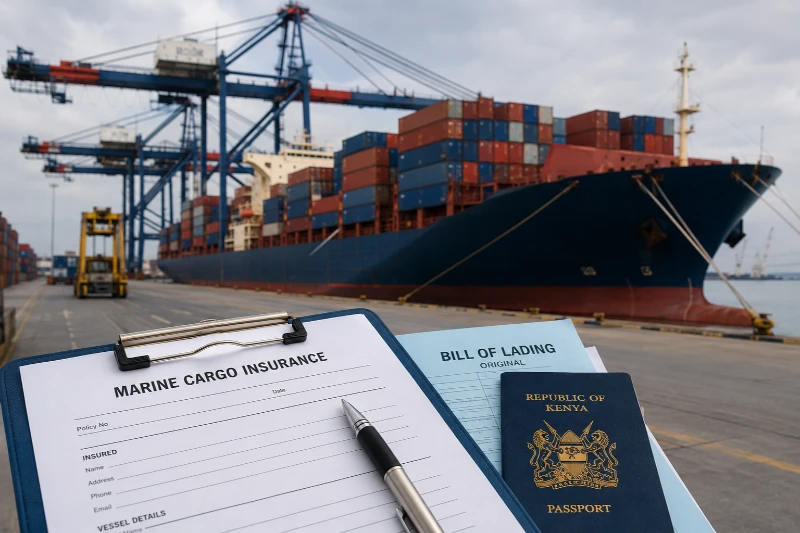
“A person with insurable interest in marine cargo shall place marine cargo insurance with an insurer registered under the Insurance Act (Cap. 487) unless prior exemption has been granted by the Commissioner.” – Section 16A, Marine Insurance Act (Cap. 390), as inserted by the Finance Act, 2017.
Introduction
Section 16A of the Marine Insurance Act (Cap. 390), introduced via the Finance Act of 2017, mandates that any party possessing an insurable interest in marine cargo must secure insurance coverage from an insurer locally licensed under the Insurance Act (Cap. 487).
For almost eight years, this legal requirement remained dormant and undermined due to the absence of enforcement mechanisms and deeply entrenched commercial practices. However, a decisive regulatory shift occurred in 2025, and as of 1st July 2026, this regime is fully digitally enforced, successfully eliminating all previous compliance workarounds.
This legal update delineates the statutory foundations, traces the enforcement timeline of this seventeen-year-old reform, and outlines the sweeping implications for importers and every stakeholder within the trade and finance ecosystem.
The Legal Basis
The enforcement regime is firmly anchored by two critical statutory provisions.
First, Section 16A of the Marine Insurance Act obligates anyone with an insurable interest in marine cargo to utilize an insurer registered under the Insurance Act, unless an explicit prior exemption is granted by the Commissioner of Insurance.
Second, Section 20(4) of the Insurance Act provides the punitive mechanism, rendering it a strict legal offence to place insurance cover with an unlicensed foreign insurer in Kenya without the Commissioner’s approval.
Read concurrently, these laws render the utilization of foreign underwriters not merely irregular, but strictly unlawful. Furthermore, the deliberately broad phrasing “any person with an insurable interest” ensures the legal burden encompasses the primary importer of record, as well as consignees, financiers, and all other parties whose economic exposure is directly tied to the cargo.
The Enforcement Story: From Dormant Statute to Live System
The transition from a theoretical paper mandate to a strict operational reality unfolded across four pivotal phases.
| Date | Milestone | Operational Impact |
| February 2025 | The Joint Directive | The Kenya Revenue Authority (KRA) and the Insurance Regulatory Authority (IRA) issued a joint directive mandating importer to digitally procure local marine insurance prior to customs clearance. Certificates were routed through IRA-connected platforms into KRA’s Integrated Customs Management System (ICMS). |
| July 2025 | Digital Enforcement Commences | Issuing infrastructure officially went live via insurer portals and mobile platforms, notably including integration with a leading telecommunications provider’s mobile money platform. Rapid market uptake led to a concentrated cluster of five insurers capturing over 55% of the marine cargo premium. |
| May 2026 | Fully Integrated Platform Announced | The IRA announced a second-generation digital platform, developed alongside Safaricom PLC, functioning in real-time to link importer portals, insurer backend systems, the eCitizen payment gateway, and KRA’s ICMS. This removed manual hand-off points that previously allowed for delays or circumvention. |
| 1st July 2026 | Full Enforcement in Force | The fully integrated digital system is now an absolute precondition for customs clearance. Cargo can no longer clear customs into Kenya relying solely upon a foreign insurer’s confirmation. |
What This Means in Practice
- Importers: You must immediately review your Incoterms. If trading on CIF or CIP terms, restructure the insurance obligation with your supplier. Ensure you obtain your digital Marine Cargo Insurance Certificate via an IRA-connected platform before initiating cargo clearance.
- Banks and Trade Finance Providers: Update standard conditions precedent and insurance covenants to require locally-issued digital certificates. Reassess the financial solvency and claims capacity of local insurers handling your collateral risk.
- Pre-existing Policyholders: Do not assume older foreign policies remain adequate. Confirm if parallel local coverage is necessary and properly document the transition to prevent unintended breaches of supply contracts or facility agreements.
- Clearing Agents and Logistics Providers: Integrate strict IDF-to-certificate verification protocols into your clearance checklist. Ensure details match prior to document lodgement to avoid automated ICMS rejections.
- Foreign Suppliers: Revise standard contracts and letters of credit where they specify insurance arrangements. Prepare for Kenyan counterparties to assume insurance procurement responsibilities.
The Bottom Line
A law that remains unenforced can lull a market into treating it as optional, but this regime demonstrates how swiftly that assumption can be overturned when political will, regulatory coordination, and digital infrastructure align.
From 1st July 2026, there is no longer a practical gap between what Section 16A requires and what the system permits. Every stakeholder in the import chain must completely align their documentation and operational practices with this enforced reality, abandoning the eight years of lenient practice that preceded it.
This article is provided free of charge for information purposes only; it does not constitute legal advice and should be relied on as such. No responsibility for the accuracy and/or correctness of the information and commentary as set in the article should be held without seeking specific legal advice on the subject matter. If you have any query regarding the same, please do not hesitate to contact Litigation Department at Litigation@wamaeallen.com
About the author

Caxstone specializes in civil, employment and labour disputes, constitutional law, family law and succession, and environment and land matters. He has amassed a wealth of knowledge and experience in litigation which is evident in the successes obtained for clients. He is an active member of the Employment and Labour Relations Court Bar-Bench committee.

Denis Mutugi specializes in Commercial Litigation and Alternative Dispute Resolution.
Denis graduated with a Bachelor of Laws, LLB (Hons) from The University of Nairobi in 2021 and was admitted to the Roll of Advocates of the High Court of Kenya in the year 2023.
Denis has amassed a considerable wealth of experience in conducting legal research on various complex legal matters touching on Commercial, Insurance, Employment and Insolvency law and bankruptcy.

Frankline M. Otieno is a dispute resolution associate, recommended professional and committed to offering sustainable client-centred solutions to legal issues.Frankline is astute in commercial litigation, securities law, banking law, intellectual property litigation, public procurement, land law litigation, Judicial Review and Administrative law litigation, sports law, tax litigation, administrative law, consumer protection law, competition law and constitutional litigation.