“Absent a waiver in the manner contemplated by the Treaty and the statute domesticating that treaty, or an established exception, this Court is bound to accord full recognition to that immunity.”
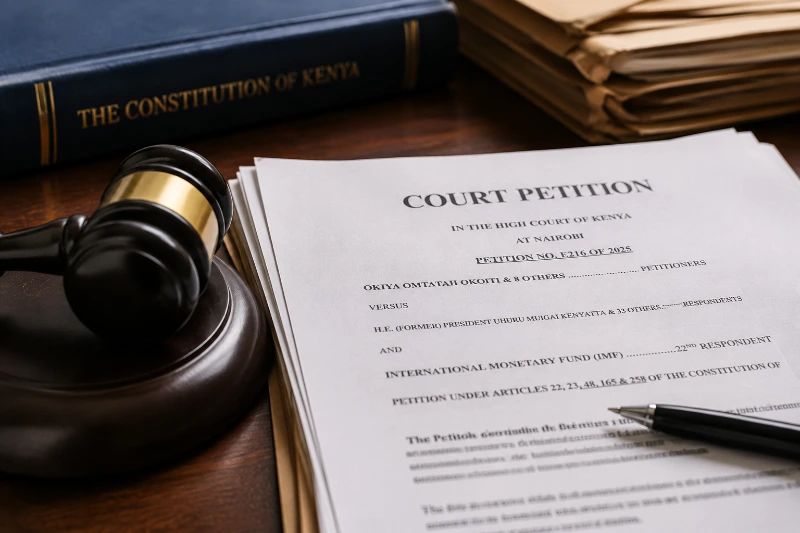
Okiya Omtatah Okoiti & 8 others v H.E. (Former) President Uhuru Muigai Kenyatta & 33 others, Petition No. E216 of 2025 [2026] KEHC 9055 (KLR) (Constitutional & Human Rights Division), Ruling on the Immunity of the 22nd Respondent (International Monetary Fund-IMF), at Nairobi, 25th June 2026.
Background
Can the International Monetary Fund be dragged before a Kenyan court to answer for the nation’s debt?
Nine petitioners, led by Okiya Omtatah Okoiti, said yes and joined the IMF as the 22nd Respondent to a sweeping constitutional challenge against public debt contracted by successive administrations, on the footing that the Fund’s on-lent loan arrangements, rolled over across financial years to an aggregate of Kshs 50 billion, sat at the heart of the impugned debt stock.
The IMF moved to be struck out, invoking Section 3 of Article IX of its Articles of Agreement, domesticated by the Bretton Woods Agreements Act, Cap 464, which shields the Fund from every form of judicial process absent an express waiver.
The petitioners countered that the Constitution reigns supreme over any treaty, that the Fund was a necessary party central to the odious-debt controversy, and that immunity of this breadth offends Articles 1, 2, 48 and 165. A three-judge bench was left to decide whether the Fund stays or walks.
Key Jurisprudential Holdings
1. A Striking-Out Application Is No Trojan Horse for Constitutional Invalidation
The Court drew a notable jurisdictional line, an application to strike out a misjoined respondent is a procedural inquiry into proper joinder not a vehicle for pronouncing on the constitutionality of the very statute or treaty conferring the immunity.
That determination belongs to a substantive petition expressly mounted under Articles 22 and 258. Absent such a challenge, the Court lacked jurisdiction to rule on the validity of the Bretton Woods Agreements Act, however forcefully the point was pressed in opposition.
2. Pre-2010 Treaties Bind- Retrospectively- Under Article 2(6)
Rejecting the submission that the 1963 Act is mere subordinate legislation incapable of shielding the Fund from constitutional scrutiny, the Court applied Kandie v Ba & another [2017] KESC 13: Article 2(6) draws no distinction between treaties ratified before or after the 2010 Constitution and operates retrospectively. The domesticated Fund Agreement is therefore part of Kenyan law, subject only to the Constitution itself.
3. Broad but Not Absolute: Immunity Falls Only on Express Waiver
Section 3, Article IX immunises the Fund from every form of judicial process except where immunity is expressly waived for particular proceedings or by contract. Comparative authority- Jam v International Finance Corp 586 U.S. (2019) and Leonard A. Sacks & Associates v IMF (D.C. Cir. 2022)– confirmed that the immunity, though not absolute, survives unless surrendered in the clearest terms. No waiver was shown; the Fund’s Assistant General Counsel deposed that none was intended.
4. Access to Justice Yields to a Reasonable, Justifiable Limitation
Bound by Article 163(7) to follow Kandie, the Court held that conferring immunity on an international financial institution- enabling Kenya to honour its international law obligations- is a reasonable and justifiable limitation of Article 48. Immunity operates as a procedural bar, not an extinguishment of substantive rights, and the balance struck by the Supreme Court could not be revisited by a court bound by its decisions.
5. Centrality to the Dispute Cannot Manufacture Jurisdiction
The petitioners’ strongest practical argument, that striking out the IMF would fragment the dispute and place the Kshs 50 billion on-lent loan beyond scrutiny, did not move the bench. Where immunity is validly conferred and unwaived, an entity’s factual centrality to the claim cannot itself vest jurisdiction. The remedy lies in a properly framed constitutional attack on the immunity-conferring instrument, not in resisting a strike-out on the merits of the underlying dispute.
The Bottom Line
The message to litigators is unmistakable as the immunity of an international financial institution operating in Kenya is displaced in only one way, a dedicated constitutional petition under Articles 22 and 258 attacking the domesticating statute or treaty itself.
Constitutional argument imported into an interlocutory strike-out will fail at the jurisdictional threshold. Practitioners acting for or against multilateral lenders, development banks and kindred treaty-bodies should audit, at the very outset, whether immunity has been waived in writing or by contract since silence, as this ruling confirms, is preservation, not surrender.
This article is provided free of charge for information purposes only; it does not constitute legal advice and should be relied on as such. No responsibility for the accuracy and/or correctness of the information and commentary as set in the article should be held without seeking specific legal advice on the subject matter. If you have any query regarding the same, please do not hesitate to contact Litigation Department at Litigation@wamaeallen.com
About the author

Caxstone specializes in civil, employment and labour disputes, constitutional law, family law and succession, and environment and land matters. He has amassed a wealth of knowledge and experience in litigation which is evident in the successes obtained for clients. He is an active member of the Employment and Labour Relations Court Bar-Bench committee.

Denis Mutugi specializes in Commercial Litigation and Alternative Dispute Resolution.
Denis graduated with a Bachelor of Laws, LLB (Hons) from The University of Nairobi in 2021 and was admitted to the Roll of Advocates of the High Court of Kenya in the year 2023.
Denis has amassed a considerable wealth of experience in conducting legal research on various complex legal matters touching on Commercial, Insurance, Employment and Insolvency law and bankruptcy.