
“The System Operator shall ensure that there is sufficient operating reserve capacity to maintain the frequency of the system under normal and emergency conditions.”
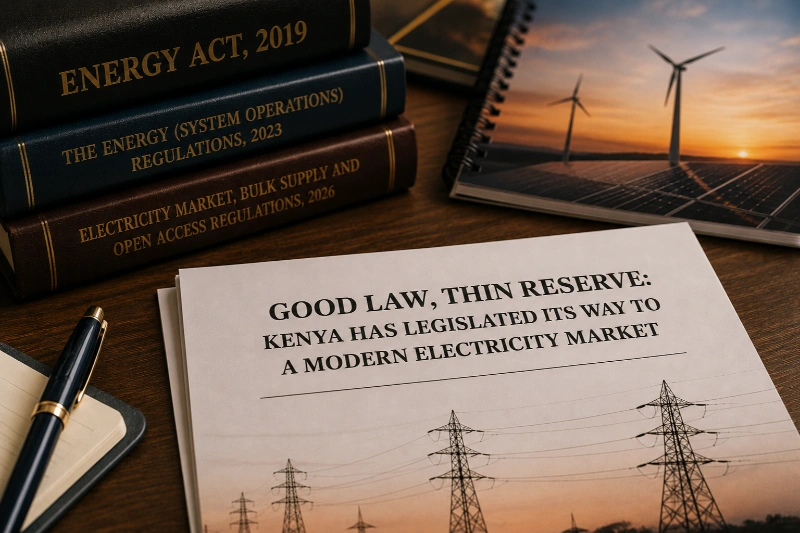
The Energy (System Operations) Regulations, 2023, read with the Kenya National Transmission Grid Code and the Energy (Electricity Market, Bulk Supply and Open Access) Regulations, 2026 (Legal Notice No. 79 of 2026) against a national reserve margin reported at 3.3% in June 2026.
Introduction
There is a moment, somewhere between seven and nine in the evening, when Kenya is at its most electrically demanding and its least electrically comfortable. The sun has set, so the solar farms have gone quiet. The security lights are up, the welding shop in the industrial area is finishing a job, and a data centre somewhere in Nairobi is drawing the same load it drew at noon. That evening hour is where the country now finds out, night after night, how much room it has left.
In June 2026, it did not have much. Kenya’s reserve margin, the spare generation held back so that the loss of a single machine does not become everybody’s blackout was reported at 3.3%. International practice puts the comfortable range somewhere between 20% and 35%. Peak demand, meanwhile, has been setting records with unwelcome regularity: 2,316 MW in June 2025, 2,514 MW in June 2026, 2,549 MW a month later.
At the same time, variable renewable energy now supplies more than 20% of grid capacity and can touch 34% at peak, against a global working benchmark of about 15% for a system without meaningful storage.
The reflex, when strain of this kind becomes visible, is to reach for the statute book. That reflex is understandable, and in this instance it is misdirected. Kenya has spent the last three years doing precisely the legal and regulatory work that this moment calls for. The problem is not that the law is silent. The problem is that the law is speaking to a grid that has not yet been built to hear it.
The Legal Architecture Kenya Has Already Assembled
The Energy Act, 2019 remains the spine of the sector: it created the Energy and Petroleum Regulatory Authority (“EPRA”), separated the regulatory function from the operational one, and placed responsibility for national energy policy and integrated planning squarely with the Cabinet Secretary. On that spine, four significant instruments have been added in quick succession.
First, the Energy (System Operations) Regulations, 2023 licensed and defined the System Operator, obliging it to schedule and despatch generation and ancillary services, to set annual operational security limits, and critically for present purposes, to ensure sufficient operating reserve capacity to hold system frequency under both normal and emergency conditions.
Second, the Energy (Net-Metering) Regulations, 2024 (Legal Notice No. 104 of 2024) allowed consumers with their own generation to export surplus power to the grid and receive credit for it, turning rooftops from private cost centres into a distributed public resource.
Third, the Energy (Integrated National Energy Plan) Regulations, 2025 (Legal Notice No. 83 of 2025) built a statutory planning cycle, twenty-year national plans, ten-year county plans, three-yearly national review so that generation, transmission and demand are projected together rather than argued about separately.
Fourth, the Energy (Electricity Market, Bulk Supply and Open Access) Regulations, 2026 (Legal Notice No. 79 of 2026), gazetted on 8 May 2026, ended Kenya Power’s position as the sole buyer and seller of bulk electricity, allowing consumers with a load of at least 1 MVA on the distribution system, or 10 MVA on the transmission system, to contract directly with independent producers on terms of one to ten years, with EPRA approving pricing and wheeling charges payable for use of the network.
Sitting above all of it, the National Energy Policy 2025–2034 has been tabled in the National Assembly as Sessional Paper No. 5 of 2026 which has invited public memoranda. It sets the long-range direction: universal access, renewable expansion, clean cooking.
Read together, that is a serious body of law. It is, by regional standards, an enviable one. It anticipates open markets, distributed generation, coordinated planning and a professionalised system operator. Very little of what Kenya needs to do next is legally prohibited.
Why the Strain Is Showing Up Anyway
Because a licence is not a turbine, and a regulation is not a battery.
A reserve margin of 3.3% is not a drafting failure. It is the arithmetic of a country whose demand has grown faster than its firm generation. No instrument, however elegantly drawn, can manufacture spare megawatts. They must be financed, procured, built, connected and commissioned, and each of those steps runs on a timeline measured in years, not gazette notices.
The renewables position tells the same story in a different register. The grid is not straining because Kenya has too much clean energy; it is straining because Kenya has not yet built the flexible capacity and storage that would let a system absorb that much variable power gracefully.
Three wind facilities including the 310 MW Lake Turkana station and five solar plants deliver roughly a fifth of national supply with almost no battery storage behind them. When output swings, frequency and voltage swing with it, and the system leans on expensive backup whose cost eventually reaches the consumer through the tariff. Reliance on imports has deepened in parallel, and a coastal floating gas plant of 200–400 MW has been floated as a stopgap. Stopgaps are, by definition, not architecture.
Open Access does not escape this logic either. The Regulations can bring an industrial consumer and an independent producer to the same table tomorrow morning. What they cannot do is shorten the three to five years it takes to build the plant that consumer has just agreed to buy from, or to string the line that will carry the power. Market liberalisation increases the number of people willing to invest. It does not compress the physics of construction.
What This Means in Practice
| Who Should Act | Immediate Action Point | Legal Basis / Commercial Driver |
|---|---|---|
| Large commercial and industrial consumers | Treat Open Access as a live procurement decision. Commission a load study, test bilateral pricing against the retail tariff, model wheeling charges, and open discussions with independent producers now rather than after the next tariff review. | Energy (Electricity Market, Bulk Supply and Open Access) Regulations, 2026 (LN 79 of 2026). Eligibility begins at 1 MVA on the distribution system and 10 MVA on the transmission system. Because new capacity takes years to build, the benefit accrues to whoever contracts first. |
| In-house counsel and contract negotiators | Re-open template supply agreements. Price interruption rather than merely reciting it: curtailment and load-shedding priority, force majeure, frequency-excursion damage, availability guarantees, liquidated damages for non-delivery, and change-in-law protection. | Direct supply agreements run for one to ten years with EPRA approval of pricing. On a 3.3% margin, the risk allocation agreed today will be lived with for the better part of a decade. |
| Independent power producers, developers and storage sponsors | Position projects against the specific constraint: battery storage, peaking and firm dispatchable capacity, and ancillary-service provision. Secure land, grid connection and offtake in parallel rather than in sequence. | The System Operator is legally obliged to maintain operating reserve and to procure ancillary services under the System Operations Regulations, 2023 and Chapters 15 and 16 of the Grid Code. That duty is a demand signal. |
| Banks, development finance institutions and project financiers | Re-price grid and offtake risk. Diligence should test the bankability of ancillary-service and reserve revenue streams, curtailment exposure, and the credit standing of the counterparty in an Open Access structure where Kenya Power is no longer the automatic offtaker. | The regulatory gap has largely closed; the physical gap has not. Bankability now turns on whether reserve procurement machinery is given real commercial content. |
| Boards, audit and risk committees | Elevate electricity continuity from a facilities matter to a board risk. Record the exposure on the risk register, review backup and storage provision, and satisfy yourselves that supply contracts allocate interruption risk deliberately. | Directors owe duties of care and skill under the Companies Act, 2015. A foreseeable and quantifiable operational risk that is not assessed is a governance failure before it is an energy failure. |
| Industry associations, consumer bodies and all stakeholders | File written memoranda on the National Energy Policy while the window is open, pressing for reserve adequacy, storage procurement and transmission funding to be treated as measurable priorities. | The National Energy Policy 2025–2034 sits before the National Assembly as Sessional Paper No. 5 of 2026, which has invited memoranda. Article 10 of the Constitution makes public participation a binding national value. |
The law has done its part. The grid is waiting.
This article is provided free of charge for information purposes only; it does not constitute legal advice and should not be relied on as such. No responsibility for the accuracy and/or correctness of the information and commentary as set out in the article should be held without seeking specific legal advice on the subject matter. If you have any query regarding the same, please do not hesitate to contact the Litigation Department at Wamae & Allen LLP: Litigation@wamaeallen.com.
About the author

Caxstone specializes in civil, employment and labour disputes, constitutional law, family law and succession, and environment and land matters. He has amassed a wealth of knowledge and experience in litigation which is evident in the successes obtained for clients. He is an active member of the Employment and Labour Relations Court Bar-Bench committee.

Denis Mutugi specializes in Commercial Litigation and Alternative Dispute Resolution.
Denis graduated with a Bachelor of Laws, LLB (Hons) from The University of Nairobi in 2021 and was admitted to the Roll of Advocates of the High Court of Kenya in the year 2023.
Denis has amassed a considerable wealth of experience in conducting legal research on various complex legal matters touching on Commercial, Insurance, Employment and Insolvency law and bankruptcy.