
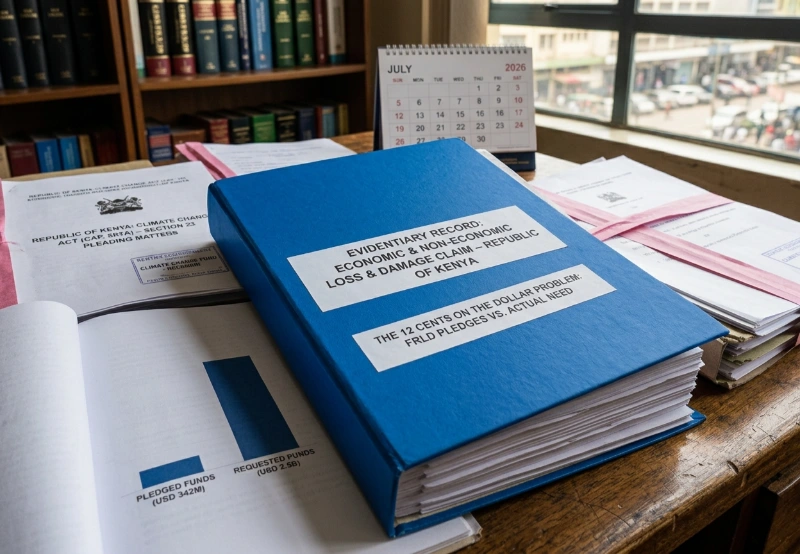
On 10th July 2026, in Manila, the Board of the Fund for responding to Loss and Damage (FRLD) sat over a pilot pipeline in which 119 developing countries had asked for USD 2.8 billion and the Fund had USD 342 million to give. Eighty-one of the 176 eligible requests came from Africa. That arithmetic, roughly twelve cents in the dollar, is the whole legal problem in a single figure, and it is why Kenyan practitioners can no longer treat loss and damage as a diplomatic file.
A Fund with No Obligation to Fill It
The FRLD was agreed at COP27 and operationalised at COP28. As at 15th March 2026 it held USD 822.06 million in pledges, of which only USD 448.64 million had actually been paid in.
The first funding cycle under the Barbados Implementation Modalities opened on 15th December 2025 with an envelope of USD 250 million, raised to USD 342 million in Manila, at least half of it reserved for least developed countries and small island developing States. The first funding package has been deferred to December 2026.
Set that against need. UNEP’s Adaptation Gap Report 2025 puts developing-country adaptation costs at USD 310–365 billion a year by 2035, against USD 26 billion of international public adaptation finance in 2023. The Independent High-Level Expert Group puts loss and damage needs at USD 200–400 billion a year by 2030. COP30’s Mutirão decision undertakes to triple adaptation finance by 2035 — without fixing a baseline against which the trebling is to be measured.
Takeaway: contributions to the FRLD are voluntary. There is no assessed scale, no obligation of result and no enforcement machinery. The Fund is a distribution mechanism, not a liability mechanism, and nothing within it converts a pledge into a debt.
Kenya at the Window: The Receiving Architecture
On 11th June 2026 at Bonn, Kenya became the first African State and the second globally, after Vanuatu to secure Santiago Network support: Sh90 million (about USD 700,000) to the State Department for Environment and Climate Change for a countrywide assessment of economic and non-economic loss and damage. That is technical assistance, not compensation. For a litigator it is the more valuable of the two, because it begins building the evidentiary record on which every future funding request and every future pleading will stand.
The receiving vehicle is the Climate Change Fund under section 25 of the Climate Change Act (Cap. 387A), administered by the Climate Change Council with the Principal Secretary running its daily operations.
The drafting repays attention: the Fund admits monies appropriated by Parliament, “donations, endowments, grants and gifts”, and monies payable to it under an Act. It was drawn for philanthropy, not for adjudicated compensation or for direct budget support subject to fiduciary covenants. Parliament should close that gap before the first award — whether from a Kenyan court or from Manila — has nowhere clean to land.
Beneath the Fund sit section 19’s county mainstreaming duties, the county climate change fund legislation rolled out under FLLoCA, and the Public Finance Management Act, 2012. The FRLD’s direct budget support modality is a fiduciary test as much as a climate one: a county whose fund regulations are not demonstrably PFM-compliant is not investment-grade for that window, however acute its exposure.
The Pleading Alternative
Kenya is one of the few jurisdictions with an express statutory climate cause of action. Section 23 of the Climate Change Act allows any person to move the Environment and Land Court, pursuant to Article 70 of the Constitution, alleging conduct that adversely affects mitigation or adaptation; the Court may restrain the act, compel a public officer to act, or award compensation and the applicant need not demonstrate personal loss or injury.
What has changed is the material now available to fill that section. In its advisory opinion of 23rd July 2025, the International Court of Justice held that States owe stringent due diligence obligations, that failure to act on climate, including fossil fuel licensing and subsidies, may constitute an internationally wrongful act, and that the consequences include full reparation: restitution, compensation and satisfaction.
ITLOS had already held, on 21st May 2024, that greenhouse gas emissions are marine pollution under UNCLOS. Neither opinion binds a Kenyan court. But Articles 2(5) and 2(6) of the Constitution make the general rules of international law and ratified treaties part of the law of Kenya, and it is through that door, not by direct enforcement, that these opinions will enter an ELC judgment.
Immediate Action Points
| Action item | Who should act | Legal basis |
|---|---|---|
| Close the section 25 of the Climate Change Act (Cap. 387A) gap: provide expressly for court-awarded damages and for direct budget support. | The National Treasury; State Department for Environment and Climate Change; Parliament. | Section 25, Climate Change Act (Cap. 387A). |
| Make county climate change funds fiduciary-ready before the next FRLD window opens. | County governments; county attorneys; county assemblies. | Section 19, Climate Change Act; Public Finance Management Act, 2012; FLLoCA. |
| Build attribution and quantum evidence now, including a methodology for non-economic loss. | Advocates; public interest organisations; affected communities. | Section 23, Climate Change Act; Article 70(3), Constitution. |
| Audit client exposure on emissions, licensing, disclosure and transition risk. | Energy, extractives, manufacturing, agribusiness and financial sector clients. | ICJ Advisory Opinion of 23.7.2025; Articles 2(5)–(6) and 42, Constitution. |
| Watch Arusha: prepare submissions and a strategy to deploy on delivery of the opinion. | The Law Society of Kenya; public interest litigators; State Law Office. | ACtHPR Advisory Opinion Request No. 001 of 2025. |
This update is intended for general information only and does not constitute legal advice, nor does it create an advocate-client relationship. For advice on climate finance structuring, county climate fund compliance, regulatory exposure or public interest litigation arising from the matters discussed, kindly contact the Litigation Department at Litigation@wamaeallen.com.
About the author

Caxstone specializes in civil, employment and labour disputes, constitutional law, family law and succession, and environment and land matters. He has amassed a wealth of knowledge and experience in litigation which is evident in the successes obtained for clients. He is an active member of the Employment and Labour Relations Court Bar-Bench committee.


Denis Mutugi specializes in Commercial Litigation and Alternative Dispute Resolution.
Denis graduated with a Bachelor of Laws, LLB (Hons) from The University of Nairobi in 2021 and was admitted to the Roll of Advocates of the High Court of Kenya in the year 2023.
Denis has amassed a considerable wealth of experience in conducting legal research on various complex legal matters touching on Commercial, Insurance, Employment and Insolvency law and bankruptcy.