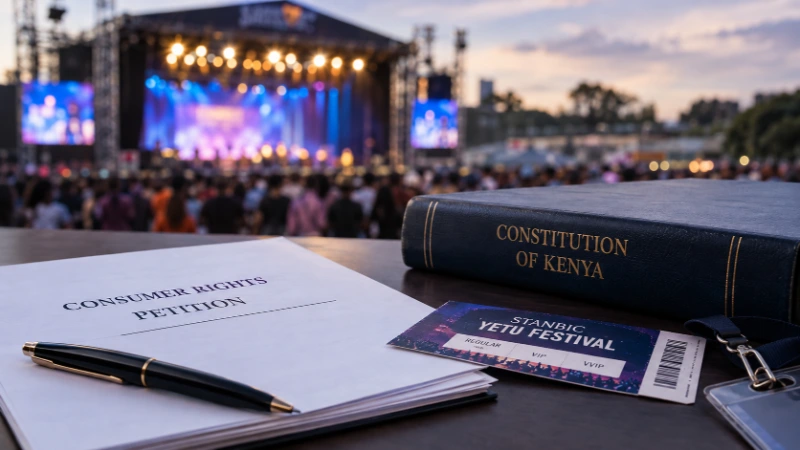
A consumer rights petition over a concert was well-pleaded but fatally undermined by the petitioner’s failure to adduce admissible evidence. The Stanbic Yetu Festival judgment distils the holding, the reasoning and the practical takeaways for every event organiser, sponsor and their counsel.
BACKGROUND
On 10th June 2023, thousands of Kenyans converged on Uhuru Gardens, Nairobi, for what had been promoted as a world-class live music experience: the Stanbic Yetu Festival, headlined by the iconic American R&B group Boyz II Men. Three categories of tickets were sold: Regular (Kshs 8,000), VIP (Kshs 15,000) and VVIP (Kshs 30,000 per pair). All tickets sold out.
The Consumer Federation of Kenya (‘COFEK’) subsequently filed Constitutional Petition No. E203 of 2023 in the High Court at Nairobi (Constitutional and Human Rights Division) on behalf of aggrieved concert-goers.
COFEK alleged that the event was a radical departure from what had been advertised marked by chaotic seating arrangements, poor sound and visual quality, obstructed views, overcrowding, inadequate sanitary facilities, security failures and the loss of personal property. The petition was brought against three respondents: Radio Africa Group/Homeboyz (the event organiser, ‘1st Respondent’), Homeboyz Entertainment Limited (the audio-visual equipment provider, ‘2nd Respondent’) and Stanbic Bank Kenya Limited/Stanbic Holdings Plc (the title sponsor, ‘3rd Respondent’).
In the aftermath of the event, the 1st and 3rd Respondents issued public statements acknowledging shortcomings and apologising for the experience. The petition was heard before Hon. Mr. Justice Lawrence N. Mugambi, who delivered judgment on 10 September 2026.
The Holding: A Petition That Pleaded Well but Proved Poorly
The petition was dismissed. Although the Court upheld the petitioner’s locus standi and rejected the doctrines of constitutional avoidance and exhaustion, the petition ultimately failed on the merits because COFEK did not discharge the burden of proof on a balance of probabilities.
In the Court’s own words:
“The Petitioner’s case was well pleaded, but it must fall for failure to discharge the burden of proof. It appears to me the pleading took the centre stage while production of admissible evidence was relegated to the back seat.”
No order as to costs was made, the Court noting the public interest nature of the litigation.
Locus Standi: The Constitutional Door Remains Open
The Court affirmed that under Articles 22 and 258 of the Constitution, any person or association may institute proceedings claiming that a right or fundamental freedom in the Bill of Rights has been denied, violated, infringed or threatened. The constitutional provisions on standing are deliberately expansive: proceedings may be brought by a person acting in their own interest, on behalf of another, as a member of a group or class, in the public interest, or by an association acting on behalf of its members.COFEK, as a registered consumer protection federation, had standing to petition even though it did not itself purchase a ticket to the event.
Constitutional Avoidance and Exhaustion: Consumer Rights Transcend Contract
The respondents argued that the dispute was essentially contractual in character: the ticket terms contained an arbitration clause, and the proper forum was arbitration, not the Constitutional Court. The doctrines of constitutional avoidance and exhaustion, they submitted, required the petitioner to pursue alternative remedies before invoking the Court’s constitutional jurisdiction.
The Court rejected both contentions. Consumer rights under Article 46 of the Constitution are constitutionally entrenched, they are not mere contractual obligations that parties may freely define or limit. A contract can complement constitutional protections—it can expand or reinforce them but it cannot take away or subtract what the Constitution or statute has provided. The arbitration clause in the ticket terms and conditions could not, therefore, oust the High Court’s jurisdiction under Article 165(3)(b) to determine whether a fundamental right had been violated.
The Evidentiary Standard: Where the Petition Fell
Consumer rights litigation requires the petitioner to prove every element of the cause of action with sufficient facts. The Court relied on Leonard Otieno v Airtel Kenya Limited [2018] eKLR and Gwer & Others v Kenya Medical Research Institute [2020] KESC 66, emphasising that the onus on the petitioner to establish violation of consumer rights “is not a mere formality; it is important.”
The Sponsor’s Shield: Title Sponsorship ≠ Operational Liability
The 3rd Respondent (Stanbic Bank Kenya Limited/Stanbic Holdings Plc) was the title sponsor of the event under a Sponsorship Agreement dated 10 April 2023. Its role, as captured in clause 2.3.1 of the agreement, was limited to the provision of financial support in exchange for brand visibility, the exclusive right to have its name featured in the title of the Yetu Festival and to benefit from defined publicity and brand placement opportunities.
The Court’s analysis aligned with the 3rd Respondent’s submissions. The sponsor had no operational, logistical or administrative participation in the planning, set-up, ticketing or execution of the concert. It did not offer any service or product to consumers, had no point of contact or commercial interaction with the revellers, and exercised no control over the consumer experience. The core elements of product liability; control, proximity and provision were entirely absent.
The sponsorship agreement further contained mutual indemnity provisions (clauses 5.1 and 5.2) confirming that each party bore liability for its own acts and was not accountable for the acts or omissions of the other.
The post-event statement of 16th June 2023, in which the 3rd Respondent acknowledged the challenges and expressed its commitment to the creative industry, was held to be a proactive corporate social responsibility step not an admission of fault or legal liability. The practical implication is clear: title sponsorship alone does not create a duty of care under Article 46 or the Consumer Protection Act absent operational control.
IMPLICATIONS FOR EVENT ORGANISERS AND THE TAKE HOME
The judgment, while dismissing the petition, is rich with practical lessons. Every event organiser, sponsor, consumer body and their counsel should take note of the following:
| Lesson / Take Home | Who Should Act |
|
Event organisers; in-house counsel |
|
Event organisers; commercial counsel |
|
Sponsors; corporate counsel |
|
Consumer bodies; public interest litigants; litigation counsel |
|
Event organisers; operations teams |
This article is provided free of charge for information purposes only; it does not constitute legal advice and should not be relied on as such. No responsibility for the accuracy and/or correctness of the information and commentary as set out in the article should be held without seeking specific legal advice on the subject matter. If you have any query regarding the same, please do not hesitate to contact the Litigation Department at Wamae & Allen LLP: Litigation@wamaeallen.com.
About the author

Caxstone specializes in civil, employment and labour disputes, constitutional law, family law and succession, and environment and land matters. He has amassed a wealth of knowledge and experience in litigation which is evident in the successes obtained for clients. He is an active member of the Employment and Labour Relations Court Bar-Bench committee.

Denis Mutugi specializes in Commercial Litigation and Alternative Dispute Resolution.
Denis graduated with a Bachelor of Laws, LLB (Hons) from The University of Nairobi in 2021 and was admitted to the Roll of Advocates of the High Court of Kenya in the year 2023.
Denis has amassed a considerable wealth of experience in conducting legal research on various complex legal matters touching on Commercial, Insurance, Employment and Insolvency law and bankruptcy.