For large-scale energy developments, risk mitigation is no longer just about engineering and finance, it is about real people and shared futures.
The massive investment brought by the Dangote Group to Lamu demonstrates that even the deepest pockets cannot bypass the deepest community conversations.
As the Special Economic Zones (Amendment) Act, 2026 aligns statutory law with a decade of judicial precedents (Baadi case-2018, Save Lamu Case- 2019, and Amu Power Case- 2025), the industry standard has shifted permanently. To protect both public interests and billionaire capital, developers must treat public participation not as a hurdle to clear, but as the foundational framework for building a genuine partnership with the host community.
1. Navigating the Capital vs. Consultation Dynamics at Kililana
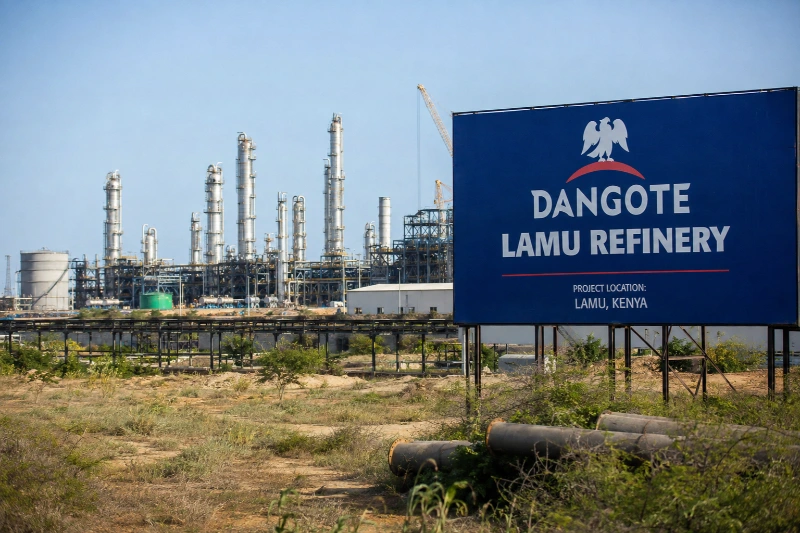
The Dangote Group has anchored its next frontier in Lamu, targeting a massive 700,000 barrels per day (bpd) refinery valued at approximately USD 17 billion (KSh2.2 trillion).
With ground-breaking slated for no later than October 2026 and an ambitious sub-four-year construction timeline, the project represents a tectonic shift for East Africa’s energy landscape.
The physical site at Kililana sits on mainland acreage largely gazetted within the Lamu Port-South Sudan-Ethiopia-Transport (LAPSSET) Special Economic Zone (SEZ). Instinctively, the State has demonstrated high-level political alignment: committing USD 165 million in seed capital, taking a minority stake through the National Infrastructure Fund, and placing the Deputy President at the helm of a dedicated coordinating committee. Funding is structured to draw from internal cash flows, corporate bonds, and an eventual public listing.
However, the financial engine cannot outrun its regulatory tracks. On 14th July 2026, Greenpeace Africa formally requested the Government to suspend all regulatory approvals until an independent Environmental and Social Impact Assessment (ESIA) is fully completed, published, and subjected to rigorous public scrutiny delivering an early warning shot of potential litigation. In other jurisdictions, a pushback of this nature might be managed as a public relations hurdle. In Lamu, it must be treated as the opening salvo of a proven litigation playbook.
2. The Statutory Sandbox: Incentives Move, Licences Stand
The Special Economic Zones (Amendment) Act, 2026, assented to in May 2026, represents a bold legislative play. It extends the coveted SEZ framework directly to upstream and midstream petroleum operations, alongside agro-processing, manufacturing, mineral, and advanced technology zones. The law guarantees a minimum ten-year licence tenure, heavily protected by mandatory annual compliance audits.
When read alongside the Income Tax Act, the fiscal allure is undeniable: a licensed enterprise enjoys a preferential corporate tax rate of 10% for the first decade and 15% for the next, providing a massive buffer against the standard 30% rate.
Furthermore:
- Customs Relief: Goods entering the zone are legally treated as sitting outside the traditional customs territory.
- VAT Optimization: Supplies to zone enterprises are zero-rated under the Value Added Tax Act, a mechanism that refunds input tax rather than merely forgiving output tax.
- Transaction Efficiencies: Instruments executed strictly for zone business are entirely relieved of stamp duty.
Two critical commercial cautions must be factored into any financial modeling.
First, whether a refinery actually qualifies for these midstream petroleum incentives depends on a strict statutory interpretation of “midstream operations” under the amended Act when harmonised with the Petroleum Act, 2019. This is a key question of legal construction, not political optics.
Second, the legislative landscape is highly fluid. The Business Laws (Amendment) Act, 2024 shifted zone benefits to a fixed timeline tied strictly to the date of licence issuance, while the state’s Medium-Term Revenue Strategy signals a deliberate institutional retreat from profit-based tax incentives. Consequently, a fiscal concession assumed in a financial model today may not survive the tenor of the project. Capital protection must be pinned to the hard text of a issued licence, never to a promotional brochure.
Five Fault Lines the Lamu File Has Already Exposed
(a) Compensation is a Judicial Decree, Not Corporate Goodwill
In the landmark Mohamed Ali Baadi case, a High Court bench empanelled under Article 165(4) of the Constitution delivered a stark reality check. The court ruled that the Lamu Port component of LAPSSET had proceeded in direct violation of the law citing deficient public participation, an incomplete environmental assessment, and a systemic disregard for the traditional rights of the local fishing community.
Rather than issuing a polite reprimand, the court ordered a massive Kshs. 1.76 billion (USD 13.5 million) compensation package to be paid directly to local fishermen within twelve months, while referring the environmental assessment back to the National Environment Management Authority (NEMA). That award was paid in full. It stands as the exact market price for getting community consultation wrong at this specific site.
(b) A Licence Without Public Participation is Void ab Initio
The National Environment Tribunal (NET) permanently altered Kenya’s infrastructure risk profile in June 2019 by revoking the EIA licence for the proposed 1,050 MW Lamu Coal Power Plant. On 16th October 2025, the Environment and Land Court (ELC) at Malindi firmly dismissed Amu Power’s appeal, upholding the cancellation by faulting the underlying report’s inadequate provisions for ash disposal, air pollution, and localized climate impacts.
The commercial lesson here is sobering: nine years elapsed between the initial licence issuance and final judicial defeat. Not a single brick was laid, yet hundreds of millions of dollars in development capital were vaporised because the proponents treated public consultation as a rubber-stamping exercise.
(c) Heritage and Culture are Justiciable Assets
The Baadi precedent also established that a project of this scale poses a quantifiable threat to the cultural fabric of Lamu, home to Lamu Old Town, a protected UNESCO World Heritage Site. Because the project lacked a robust preservation strategy and failed to conduct deep-tier community dialogues, the court treated this omission as a direct violation of the constitutional right to culture.
In Kenya, Articles 11 and 44 of the Constitution are not ornamental prose; they are actionable legal landmines capable of halting a multi-trillion-shilling supply chain.
(d) Land Security Precedes the Ground-Breaking Ceremony
The mere gazettement of an industrial zone does not automatically extinguish underlying historical land claims. Host communities across Kililana, Kwasasi, Mashunduani, and Magogoni maintain that previous land acquisitions for both the port and military installations remain uncompensated.
Under Article 40(3) of the Constitution and Part VIII of the Land Act, 2012, prompt, full, and just compensation is a non-negotiable prerequisite for land possession, while community holdings are heavily guarded by the Community Land Act, 2016. For midstream investors and secondary developers purchasing adjacent land for housing, storage, or logistics yards, unregistered, communal, and ancestral tenure means that verifying the “root of title” is the transaction itself, not a administrative formality to be rushed through.
(e) Local Content is Statutory, but the Mechanics Remain Fluid
Sections 50 to 52 of the Petroleum Act, 2019 legally mandate the prioritization of local goods, services, and personnel, qualified only by the competitive “prevailing market rate” proviso. However, the operational machinery is incomplete: the Petroleum (Local Content) Regulations are stuck in draft form, and the Local Content Bill, 2023 continues to sit before the Senate.
Any project proponent quoting fixed local content quotas or relying on standardized compliance frameworks today is effectively quoting draft legislation. Until these regulations are formally gazetted, local participation, skill transfers, and procurement targets must be aggressively secured within custom private contracts, rather than assumed from the state gazette.
Operational Strategy: What It Means on Monday Morning
For project sponsors, financiers, and contractors looking to deploy capital safely into the Lamu Basin, corporate strategy must pivot around five hard operational rules:
- Demand the Licence, as Section 58 of the Environmental Management and Co-ordination Act (EMCA) establishes an approved assessment licence as an absolute condition precedent to breaking ground. Project mobilization, debt drawdown, and long-lead equipment procurement must be contractually conditioned not just on the issuance of the NEMA licence, but on the absolute closure of all statutory appeal windows.
- Elevate Community Engagement to a Legal Work-StreamThe Baadi ruling proved that cutting corners on public consultation transforms a communication oversight into a nine-figure liabilities decree. A meticulous, audio-visually documented public participation record, a transparent grievance redress mechanism, and a legally structured community benefit vehicle are not Corporate Social Responsibility (CSR) initiatives they are core risk-mitigation instruments.
- Anchor Your Fiscal Position Directly to the LicenceDeveloper, operator, and enterprise licences carry completely distinct compliance obligations. Ring-fenced accounting and real-time reporting to the SEZ Authority are the ongoing costs of retaining your tax benefits. Financial models must be built defensively, accounting for the 2024 statutory restructurings and the state’s aggressive revenue-mobilization strategies.
- Structure Specialised Joint Ventures ImmediatelyBecause the state’s local content regulations remain unmade, the law will not protect you from vague local expectations. The only enforceable obligations regarding technology transfer, equity splits, profit sharing, and intellectual property will be the highly customized, airtight contracts that parties author for themselves today.
The Bottom Line
Lamu is the most heavily litigated industrial development corridor in East Africa. The Kenyan State was forced to pay KSh1.76 billion for getting consultation wrong there once, and a licence for a KSh200 billion power plant was completely neutralized, remaining dead through nine years of relentless appeals.
The Dangote Refinery may well become the largest private capital deployment in the history of the country, but it will not be insulated by its scale, nor will it be made lawful by a press conference. For any serious player positioning around the Lamu Basin, the project is not the physical site, the project is the file. Success hinges entirely on the bulletproof alignment of your licence, your title, your contract, and your consultation record.
This article is provided free of charge for information purposes only; it does not constitute legal advice and should be relied on as such. No responsibility for the accuracy and/or correctness of the information and commentary as set in the article should be held without seeking specific legal advice on the subject matter. If you have any query regarding the same, please do not hesitate to contact Litigation Department at Litigation@wamaeallen.com
About the author

Caxstone specializes in civil, employment and labour disputes, constitutional law, family law and succession, and environment and land matters. He has amassed a wealth of knowledge and experience in litigation which is evident in the successes obtained for clients. He is an active member of the Employment and Labour Relations Court Bar-Bench committee.

Denis Mutugi specializes in Commercial Litigation and Alternative Dispute Resolution.
Denis graduated with a Bachelor of Laws, LLB (Hons) from The University of Nairobi in 2021 and was admitted to the Roll of Advocates of the High Court of Kenya in the year 2023.
Denis has amassed a considerable wealth of experience in conducting legal research on various complex legal matters touching on Commercial, Insurance, Employment and Insolvency law and bankruptcy.

Nadio George is a dedicated Advocate of the High Court of Kenya, passionate about legal excellence, societal progress, and environmental stewardship. Admitted to the Roll of Advocates in 2023, he combines deep legal expertise with a strong commitment to making meaningful contributions to both the legal profession and the community.

Frankline M. Otieno is a dispute resolution associate, recommended professional and committed to offering sustainable client-centred solutions to legal issues.Frankline is astute in commercial litigation, securities law, banking law, intellectual property litigation, public procurement, land law litigation, Judicial Review and Administrative law litigation, sports law, tax litigation, administrative law, consumer protection law, competition law and constitutional litigation.