INTRODUCTION
Most employment judgments turn on what an employer did. This one turns on what an employer failed to prove.
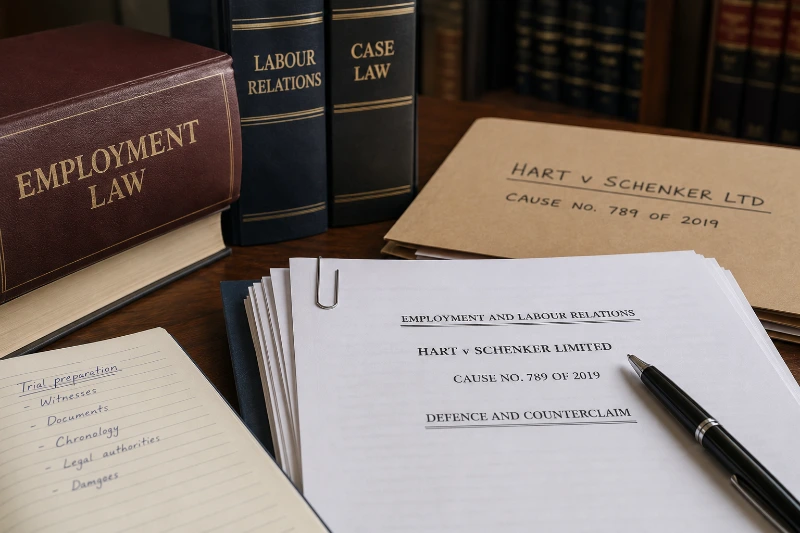
Larissa Hart resigned as Schenker Limited’s Mombasa Branch Manager in February 2017, after close to four years in the role, and sued for constructive dismissal in 2019. Schenker denied everything, said the restructuring was legitimate cost-cutting, and counterclaimed for three months’ salary in lieu of notice. It then allowed its own case to lapse. The Court had to decide what survives on a record where one side’s case exists only on paper, and whether that silence, by itself, decides anything.
The answer travels well beyond this file. Any HR function that has issued a warning without a hearing, quietly redrawn a reporting line, or left a written grievance unanswered will recognise its own practices in this judgment. Any employee who has stayed on, complained internally and wondered whether the file they have been keeping is worth anything will find the answer here too.
A YEAR OF SMALL CUTS: WHAT ACTUALLY HAPPENED
Ms Hart’s case was not built on one dramatic incident. It was built on a year of them: two public dressing-downs on conference calls; an unexplained change to her reporting line; a Final Warning Letter issued without any hearing, on an otherwise clean record; an Open Letter to nine senior executives that drew no response at all; and, finally, a refused travel letter for her son’s swimming competition.
She resigned, citing that year. Schenker’s answer was that the reorganisation was genuine and commercially driven, an answer that, on the record ultimately before the Court, no witness ever gave.
WHAT THE CASE MEANS IN THE MARKET
For employers and HR teams
Restructuring seasons produce exactly this fact pattern: a reporting line redrawn on a slide, a performance letter issued to “put something on file”, an escalation email that nobody owns. Each is defensible in isolation; together they are the raw material of a repudiation claim. Three habits materially reduce that exposure, hold and minute a hearing before any sanction, answer written complaints in writing within a stated timeline, and never let the executive complained about be the executive who decides the complaint. And when a claim does come, budget for the witness, not just the pleading: the cost of an unavailable Managing Director here was eight months’ compensation and a dead counterclaim.
For employees
The record you build while you are still employed is the case you will run afterwards. Ms Hart won on documents; her contract, the warning letter, her payslips, her unanswered open letter, without a single corroborating witness. Complain in writing, keep copies outside the work system, and state your reasons when you resign. Staying on for months while genuinely pursuing internal resolution will not be held against you; passive acceptance would be. But sympathy does not substitute for arithmetic: the two claims she lost were lost because they were neither properly quantified nor proved.
For in-house counsel and litigators
Trial discipline is the whole judgment. Decide who testifies before you file, not after the fourth adjournment; adopt statements on oath; produce documents through witnesses; object to disputed electronic evidence when it is tendered rather than in submissions; and treat a counterclaim as a claim you must prove and file within time, not as ballast for the defence.
THE BOTTOM LINE
Hart v Schenker is a case about trial discipline rather than dramatic facts. Pleadings are not evidence; witness statements are not evidence until adopted; documents are not evidence until produced and proved. A defendant’s silence does not hand the claimant an automatic win, but it is rarely costless, least of all where the silent party is the one person who could have explained the conduct in dispute. A defence that lives only on paper, however carefully drafted, is no defence at all once the time comes to prove it.
IMMEDIATE ACTION POINTS
| Action Item | Who Should Act | Legal Basis |
|---|---|---|
| Pair every disciplinary sanction with a hearing before it is issued, and minute it. A “final” warning delivered to an employee with a clean record, without a hearing, was treated here as a building block of repudiation, not as ordinary performance management. | HR; line management | ss. 41 & 45, Employment Act, 2007 |
| Answer written grievances in writing, and never route a complaint to the person it is about. Appoint an alternate hearer where the complaint touches the Managing Director or the reporting line above the complainant. | HR; board / ExCo; in-house counsel | Grievance policy; ss. 45 & 47, Employment Act, 2007 |
| Confirm reporting-line, title and role changes in writing, with reasons, before they take effect. An unexplained change of reporting line reads objectively as a demotion in substance, whatever the intention behind it. | HR; line management | Contract; Coca-Cola v Ligaga (repudiatory breach) |
| Decide at the pleadings stage who will testify, and keep them available. Four deferrals and an absent Managing Director left the only first-hand account of the disputed conduct entirely untested. | In-house counsel; external counsel | Evidence Act (Cap. 80), ss. 107–109 |
| Keep, date and file the paper trail of every internal complaint, appeal and unanswered letter. Documents, unshaken, carried this claim without a single corroborating witness. | Employees; HR (retention) | Evidence Act (Cap. 80), ss. 112 & 143 |
This article is provided free of charge for information purposes only; it does not constitute legal advice and should be relied on as such. No responsibility for the accuracy and/or correctness of the information and commentary as set in the article should be held without seeking specific legal advice on the subject matter. If you have any query regarding the same, please do not hesitate to contact our Employment and Labour Relations Department vide WAELR@wamaeallen.com
About the author

Caxstone specializes in civil, employment and labour disputes, constitutional law, family law and succession, and environment and land matters. He has amassed a wealth of knowledge and experience in litigation which is evident in the successes obtained for clients. He is an active member of the Employment and Labour Relations Court Bar-Bench committee.

Frankline M. Otieno is a dispute resolution associate, recommended professional and committed to offering sustainable client-centred solutions to legal issues.Frankline is astute in commercial litigation, securities law, banking law, intellectual property litigation, public procurement, land law litigation, Judicial Review and Administrative law litigation, sports law, tax litigation, administrative law, consumer protection law, competition law and constitutional litigation.

Denis Mutugi specializes in Commercial Litigation and Alternative Dispute Resolution.
Denis graduated with a Bachelor of Laws, LLB (Hons) from The University of Nairobi in 2021 and was admitted to the Roll of Advocates of the High Court of Kenya in the year 2023.
Denis has amassed a considerable wealth of experience in conducting legal research on various complex legal matters touching on Commercial, Insurance, Employment and Insolvency law and bankruptcy.